
The ALTO Project for Landowners
An Overview of the High-Speed Rail Network Act & Answers to Common QuestionsPublished:
The ALTO Project
In February 2025, the federal government announced the ALTO high-speed rail project, a proposed system expected to span approximately 1,000 km and intended to connect stations in the Toronto-Quebec City corridor. If constructed, it would represent one of the largest transportation infrastructure projects in Canadian history.
In March 2026, Bill C-15 came into force and enacted the High-Speed Rail Network Act. This Act provides the legal framework for the ALTO high-speed rail network, including powers and processes that differ from the ordinary federal expropriation process.
The purpose of this article is to provide a practical overview of the legislation changes that have been made regarding the ALTO project and answer some common landowner questions.
How Will I Know if My Property Is Affected?
Landowners often assume that they will only know if their land will be affected when ALTO decides to expropriate their property. However, there are several indications that your land may be affected before the formal expropriation process is initiated.
First, you can consult the mapping on the ALTO website to identify if your property is in the proposed study corridor. It is important to remember, however, that the study corridor is not the final route and inclusion in the corridor does not necessarily mean your property will ultimately be expropriated or acquired.
Second, ALTO has indicated that it intends to negotiate acquisition with landowners where possible if their property will be affected by the project. ALTO has indicated that it intends to make initial contact with landowners by letter regarding the acquisition process.
Third, you may receive various notices including a Notice of Right of First Refusal and/or a Notice of Prohibition on Work. These notices are explained below and may affect both the use of your property and your ability to sell it.
Lastly, if ALTO ultimately decides to expropriate your property, you will receive a Notice of Intention to Expropriate to initiate the formal expropriation process. ALTO has also indicated that it will communicate its intent to expropriate during the negotiation process with the landowner outlined above.
Important Notices to Understand
The legislation changes introduced with the enactment of the High-Speed Rail Network Act streamlined the expropriation process but also introduced notice powers that can be exercised prior to the initiation of the formal expropriation process.
The following summarizes the two types of notices a landowner may be affected by before the commencement of expropriation proceedings:
1. Notice of Right of First Refusal
A notice may be registered on title to your property restricting certain activities such as new construction, development, excavation or other improvements that could interfere with the rail project. Notices of this type can be valid for up to 4 years. Unlike the right of first refusal notice, the legislation provides for compensation to landowners receiving this form of notice.
What Should I Do if I Receive a Notice?
In general, landowners that receive either a Notice of Right of First Refusal or a Notice of Prohibition on Work should take the following precautions:
➢ Consult a lawyer experienced with expropriations as soon as possible;
➢ Preserve important records including any appraisals or evidence of existing site conditions;
➢ Document any losses incurred as a result of the notice;
➢ In consultation with your lawyer, engage other professionals as required; and
➢ Do not assume compensation is limited to land value.
While a notice does not necessarily mean your property will be acquired or expropriated, it should be taken seriously. Landowners who understand the implications of a notice and obtain legal advice early will be better positioned to protect their rights and any future compensation claims.
The ALTO Expropriation Process After Bill C-15
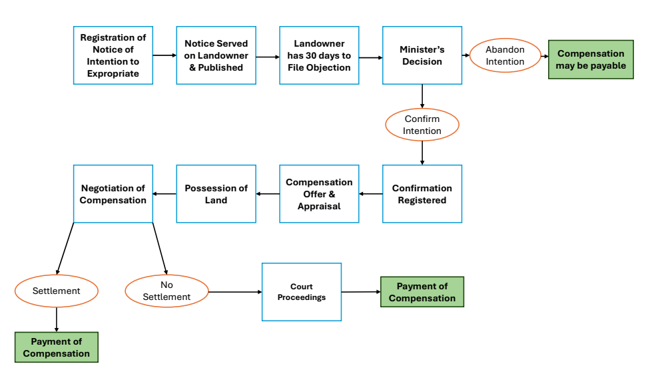
Following the enactment of the High-Speed Rail Network Act, the federal expropriation process has changed. The below diagram provides a high-level overview of the various stages of the expropriation process specific to the ALTO project:
What Compensation Am I Entitled to If My Property Is Affected?
While the High-Speed Rail Network Act streamlines the expropriation process for the ALTO project it does not eliminate a landowner’s right to fair compensation. In most expropriation cases the primary issue between the expropriating authority and the landowner is not whether the land can be taken but rather what compensation the landowner is entitled to as a result of the expropriation.
Compensation entitlement can be complex and is highly case-specific. However, the following forms of compensation may be available if your land is acquired or expropriated as a result of the ALTO project:
1. Market Value of the Land Taken: this reflects compensation for the amount that a purchaser would pay in an open-market transaction. Various factors, including location, permitted uses, development potential and existing improvements, can influence a property’s market value assessment.
5. Compensation for a Notice of Prohibition on Work: as previously noted, landowners that are subject to a Notice of Prohibition on Work are entitled to compensation for actual losses resulting from the notice together with certain appraisal and legal costs.
It is important as a landowner that you do not assume the only compensation that you are entitled to is for the market value of the land actually taken. The compensation payable may vary depending on the nature and extent of an impact on a property. As a result, it is important to retain the appropriate experts to assist in valuating and negotiating the total compensation package.
Common Landowner Mistakes
Expropriation is a complex and unfamiliar process for many landowners. As a result, landowners can sometimes make decisions that adversely affect their rights or reduce the compensation ultimately available to them. The following are examples of common mistakes that landowners should avoid if they anticipate that their land may be affected by the ALTO project:
➢ Assuming compensation entitlement is limited to the market value of the land taken;
➢ Waiting too long to obtain legal or other professional advice;
➢ Failing to keep adequate records and document the existing condition of the land;
➢ Assuming the initial compensation offer is final;
➢ Overlooking the overall compensation available for a partial expropriation; and
➢ Ignoring notices or statutory deadlines.
What Should I Do to Ensure My Rights Are Protected?
Even if you have not yet received a notice or letter described in this article, there are steps that can be taken now to ensure your interests are protected in the event your land is affected by the ALTO project and that will place you in the best possible position with respect to a compensation claim.
Specifically, it is important for landowners to:
➢ Stay informed: keep up to date regarding the project status by monitoring project announcements, proposed routes, public consultation materials and any correspondence or notices received from ALTO or the federal government;
➢ Keep Detailed Records: retain documents such as surveys, property assessments and appraisals, development applications and approvals, agricultural records, business and financial records, environmental and engineering reports and photographs of the existing condition to help establish the property’s value and existing uses as well as any losses incurred. It is also important to document future plans for your property that may be affected by the project;
➢ Track Project-Related Impacts: keep records of any impacts on your property that result from the project; and
➢ Obtain professional advice early: obtain legal and other professional advice as soon as possible if you expect your property may be affected by the ALTO project and especially if you receive any of the notices or letters outlined in this article. Early advice can help identify potential issues, preserve evidence and ensure important deadlines are not missed.
Conclusion
While the prospect of your land being affected by the ALTO project may seem daunting, particularly given the legislative changes introduced by the High-Speed Rail Network Act, it is important to understand that you have rights with respect to the process and compensation entitlements arising from impacts on you and your property.
While the legislative landscape has changed with respect to how the process will proceed, there remains significant opportunity to protect your rights and ensure that you are fairly compensated for any impacts that occur.
This article provides a high-level overview of the legislation and expropriation process related to the ALTO project. However, it is important to seek legal advice tailored to your specific circumstances, as compensation entitlement and the protection of your rights are highly case-specific.
Should you have any questions about how our firm can assist you if you anticipate that your property may be impacted by the ALTO project, please do not hesitate to contact us.
The foregoing should not be considered to be legal advice and should not be relied upon as such. Please consult a lawyer to get advice and an opinion on your unique circumstances.
